
Evidence-led beginner guide
How to Store Wenwan Walnuts So They Age Normally
Good storage is quiet risk management. It does not guarantee a certain colour or prevent every natural change. It keeps the pair away from obvious stresses—direct heat, intense sun, trapped dampness, crushing contact, and abrupt environmental swings—so handling history remains easier to understand.
Background
Walnut shells are organic structures that exchange moisture with their environment. Research on walnut shells shows moisture and drying behaviour are connected to crack formation, although edible-walnut experiments are not a complete care manual for collectible Wenwan pairs. The practical conclusion should remain conservative: do not soak a dry shell, do not force rapid drying, and do not leave the pair in extreme heat.
In plain terms
Stable storage means a clean, shaded, ventilated place with no sudden heat or moisture event, enough protection from impact, and regular checks for cracks, odour, residue, insects, or condensation.
Why it matters
A pair can be handled carefully and still be damaged while unused. A hot vehicle, sunny windowsill, damp sealed pouch, or heavy object can create a problem that no later polish can reverse. Simple storage also protects the photo record by reducing unexplained environmental variables.
A step-by-step approach
- Choose an interior location. Use a stable shelf or drawer away from windows, exterior walls with condensation, radiators, vents, cooking steam, and bathrooms.
- Use a clean breathable holder. A clean cloth pouch or ventilated container can protect against dust and impact. Do not seal a damp pair into plastic.
- Separate the shells from hard objects. Prevent keys, tools, jewellery, or other walnuts from pressing on tips and edges during storage or transport.
- Dry the hands and pair before putting away. If the surface feels damp, pause and let it return naturally in a shaded ventilated area before storage.
- Inspect on a schedule. Once a week during early ownership or seasonal change, check seams, tips, base, odour, surface feel, and the storage container.
- Record unusual events. Note travel, extreme weather, accidental wetting, a drop, or a change of room. Photographs make later comparison more reliable.
How to judge it
- The storage space stays dry to the touch and does not smell musty or chemically strong.
- The pair is protected from direct light and contact with harder objects.
- No condensation forms inside the holder and no surface remains damp when stored.
- Seasonal changes are handled gradually rather than with direct heating or forced cooling.
Original photo evidence
These photographs were taken for Play Walnut. The notes describe only what the image can support and state what remains unknown.
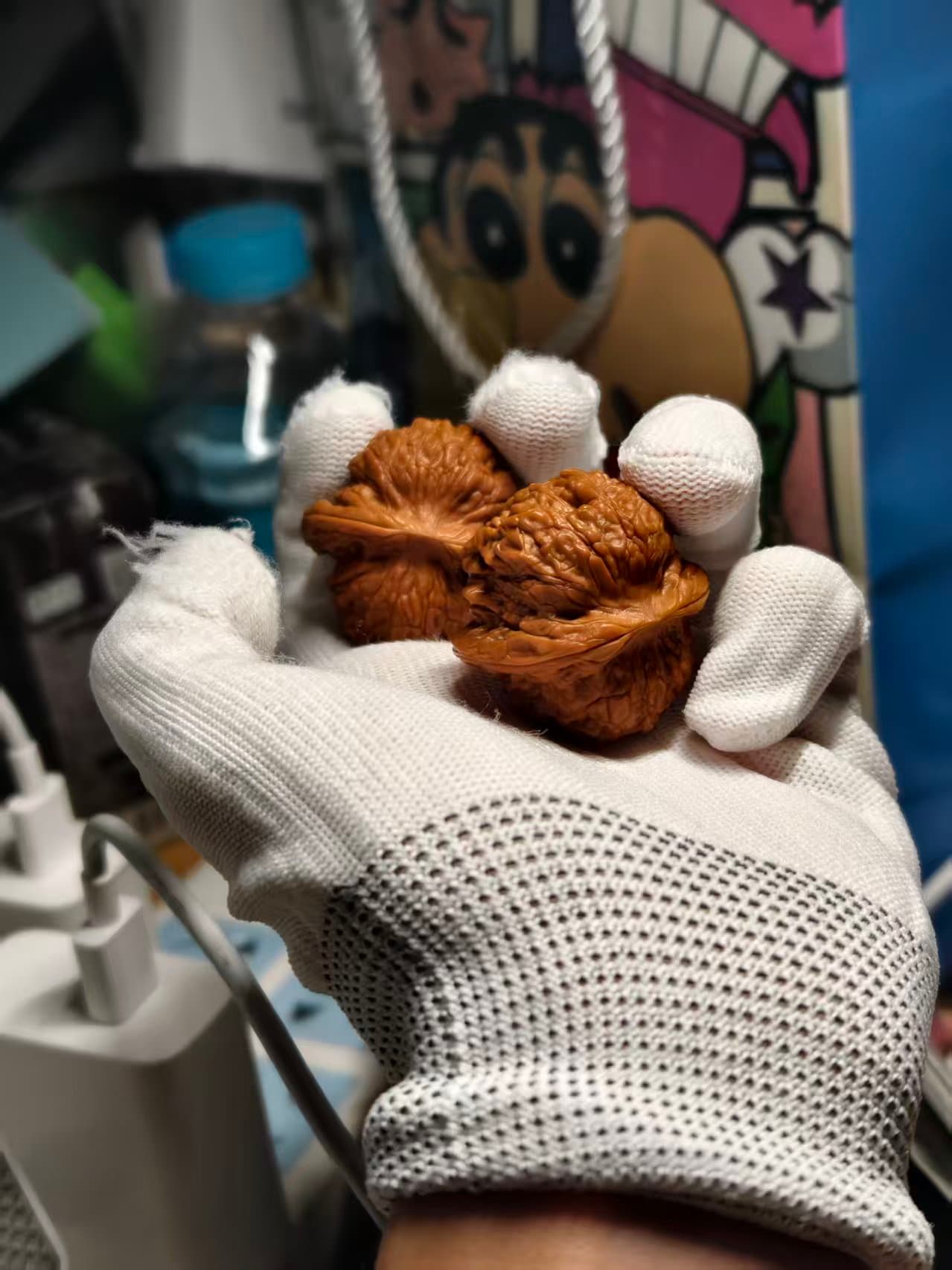
Original whole-pair storage reference
What to observe: A reference photograph before storage helps identify later chips, seam changes, or new residue.
What this photo cannot prove: The image cannot record humidity, temperature, impact history, or conditions inside a closed container.
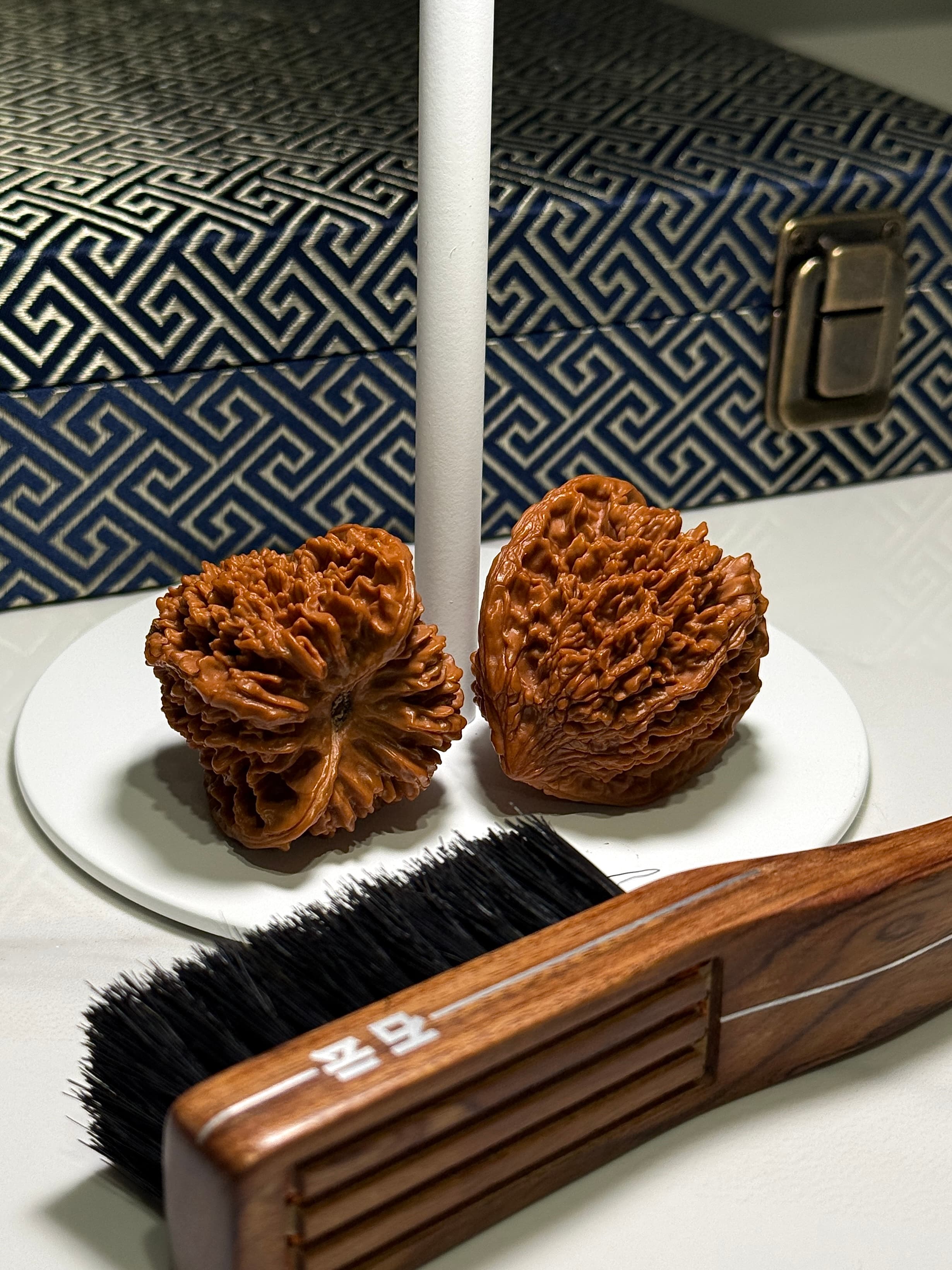
Original surface reference for periodic inspection
What to observe: Repeat the same angle during seasonal checks and look for new structural lines rather than only colour.
What this photo cannot prove: Apparent colour differences may come from lighting; structural concerns need closer inspection.
Original photography and editorial analysis by Play Walnut Editor.
Real-world examples
- A pair left in a parked car experiences intense heat. The safer routine is to carry it indoors rather than treating the vehicle as a storage box.
- A damp pair is sealed in a plastic bag after handling. Trapped moisture and odour appear later; a breathable shaded drying period would have reduced the risk.
- Two walnuts travel loose with keys. Repeated impacts chip a high point even though the owner never dropped the pair during practice.
Common mistakes
- Displaying the pair in direct sunlight for long periods.
- Using a heater or hair dryer after accidental dampness.
- Sealing moisture into an airtight bag or box.
- Adding unverified humidity products directly beside the shells.
- Leaving the pair loose among hard objects during transport.
Advice for first-time owners
Do not chase a perfect humidity number with uncalibrated gadgets or wet materials. First remove obvious extremes and keep the routine consistent. If your local climate is unusually dry or humid, make gradual changes and monitor the actual pair. A conservator or experienced local collector can help with a condition-specific problem, but no storage method can guarantee a crack-free shell.
Key takeaways
- Avoid extremes and abrupt change rather than chasing a universal climate number.
- Never store a damp pair in a sealed holder.
- Protect tips and edges from pressure and impact.
- Regular inspection and event notes turn storage into an understandable routine.
Frequently asked questions
Should Wenwan walnuts be kept in a sealed plastic bag?
Not as a default. A sealed bag can trap moisture and odour. Use a clean breathable holder unless a condition-specific professional recommendation says otherwise.
Can I keep the pair on a display shelf?
Only if the shelf is stable, shaded, and protected from heat, moisture, dust, pets, children, and falling objects. A sunny windowsill is not stable storage.
What should I do after accidental wetting?
Stop handling, blot free surface moisture without rubbing, document the condition, and let the pair dry gradually in shade with airflow. Avoid direct heat and inspect seams or repairs.
The short version
Storage works when it is uneventful. Keep the pair clean, shaded, ventilated, separated from hard objects, and away from sudden heat or moisture. Regular checks and photographs provide more protection than a complicated collection of accessories.
Sources, method, and limitations
- Research on moisture-driven cracking in walnut shells — Supports the conservative advice to avoid abrupt wetting, intense heat, and rapid moisture change; the study is not a Wenwan care manual.
- Play Walnut preventive storage protocol — The advice applies a conservative risk-reduction approach and does not promise a universal humidity target or crack-proof result.