
Evidence-led beginner guide
How to Spot Repair and Misleading Claims in Wenwan Walnut Pairs
A photograph cannot certify a Wenwan walnut pair as real or fake. It can, however, reveal questions about cracks, filler, heavy polish, dye, mismatching, and unsupported claims. The goal of this guide is not remote authentication; it is to help a beginner collect enough evidence to avoid a misleading purchase.
Background
The word “fake” can describe several different problems: a resin imitation, a natural shell sold under an unsupported variety name, two unrelated shells presented as a pair, or a heavily repaired pair described as untouched. Those problems require different evidence. A careful buyer therefore replaces one yes-or-no question with a sequence of specific checks and asks the seller to disclose treatment history.
In plain terms
Restoration is any repair or surface treatment intended to stabilise or change the appearance of a shell. Restoration is not automatically dishonest; the risk comes when it is hidden, misdescribed, or priced as untouched. Authentication requires more than a single photograph.
Why it matters
A repaired pair can still be educational or enjoyable when the work and price are disclosed. Hidden repair creates a condition and trust problem. It can also fail during handling, leaving the buyer with damage that appeared only after the return period.
A step-by-step approach
- Request complete views. Ask for top, sides, base, seam, tip, and close-ups of any dark line or glossy patch. Repeated top views do not substitute for missing angles.
- Inspect transitions. Look where colour, sheen, or texture changes abruptly. Filler or coating may bridge a groove, soften an edge, or reflect differently from the surrounding shell.
- Compare the two halves. Check whether size, outline, texture direction, wear, and colour history appear related. Natural variation is normal; unexplained conflict deserves questions.
- Ask direct treatment questions. Ask whether the pair has been cracked, glued, filled, dyed, oiled, waxed, polished, re-paired, or otherwise restored. Save the answer.
- Check claims against evidence. A variety, origin, age, or rarity claim should have documentation beyond appearance. Treat confident adjectives without support as marketing.
- Record the arrival condition. Photograph the unopened package and the pair before cleaning or handling. Compare it with the listing while return options remain available.
How to judge it
- An abrupt line that crosses natural texture is more important than a small colour variation that follows the surface.
- A repair should be disclosed and evaluated for stability, appearance, intended use, and price.
- A matched pair should look related, but perfect mechanical identity is not required or expected.
- Unsupported species, origin, age, and investment claims remain unknown even when the shell is natural.
Original photo evidence
These photographs were taken for Play Walnut. The notes describe only what the image can support and state what remains unknown.
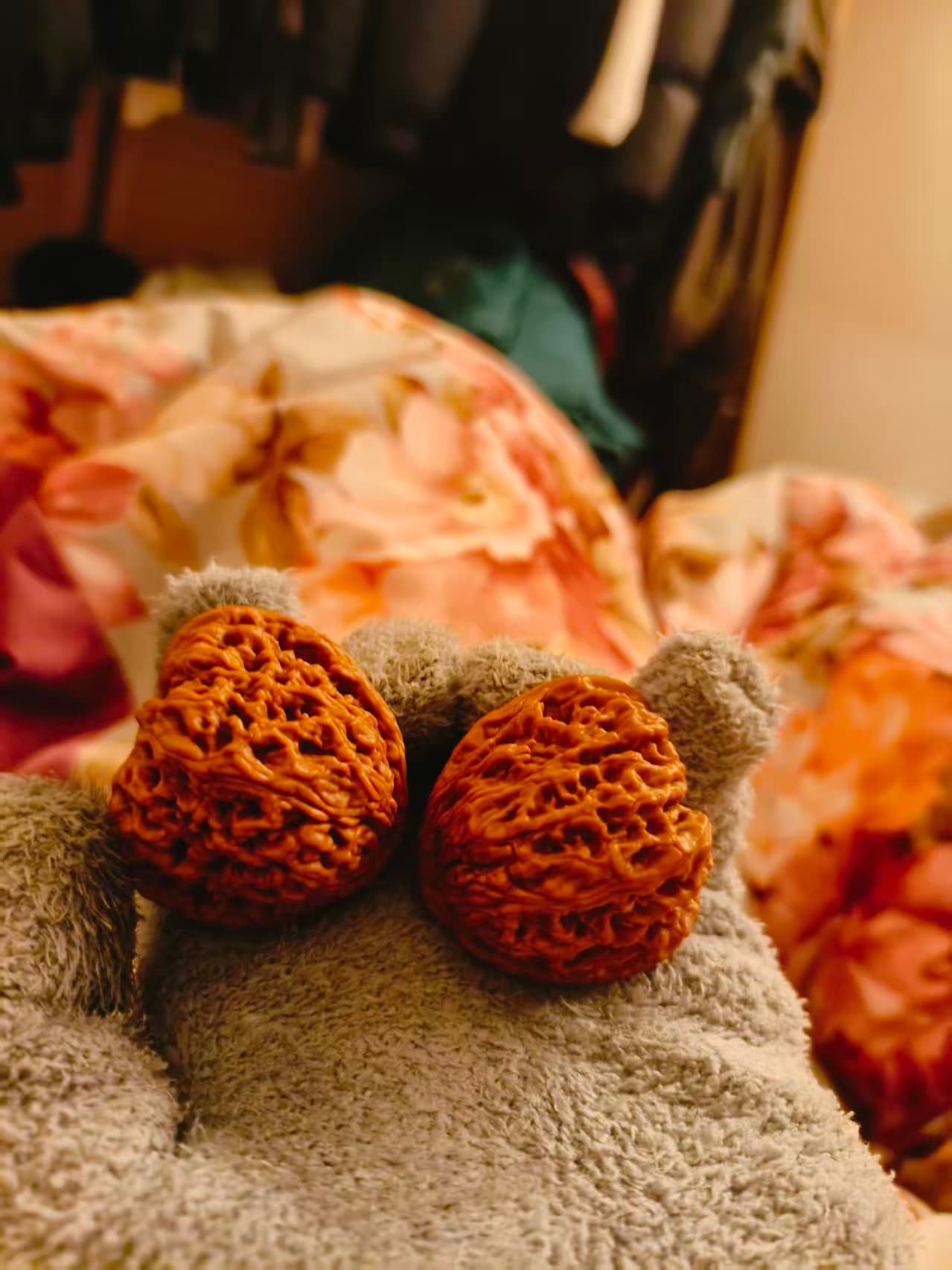
Original condition-study photograph
What to observe: Use a fixed scan across high points, grooves, seams, and base areas to identify locations that need another angle.
What this photo cannot prove: A suspicious-looking area is not proof of repair; tactile inspection, history, and clearer images may be necessary.
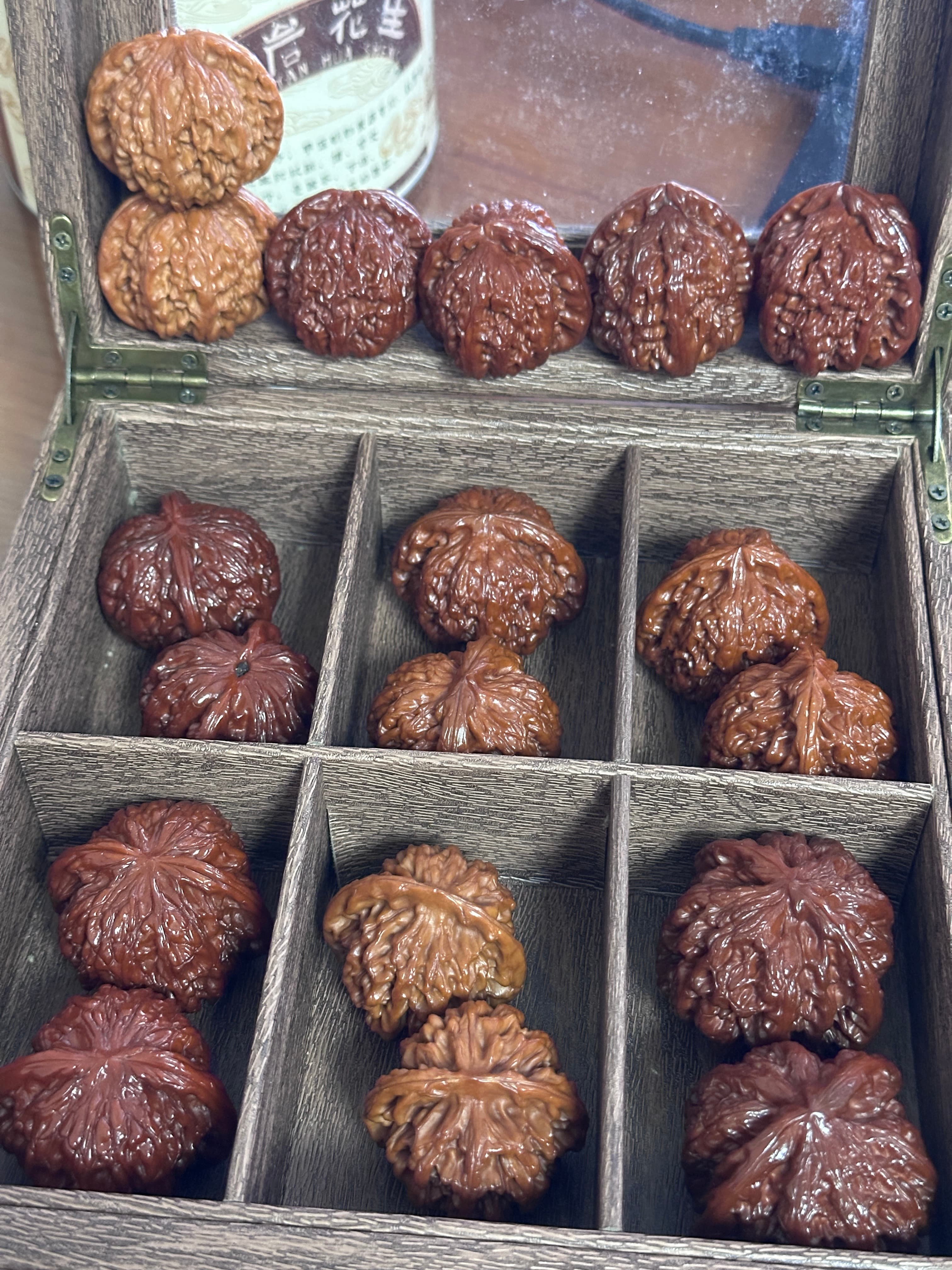
Original reference for examining hidden areas
What to observe: Focus on transitions where texture, colour, or sheen changes rather than judging overall darkness.
What this photo cannot prove: The photograph cannot determine the material below the surface or establish seller intent.
Original photography and editorial analysis by Play Walnut Editor.
Real-world examples
- A glossy patch spans several grooves and remains bright from every angle. The seller later confirms a clear filler used over a repaired area. Disclosure changes how the pair should be valued and handled.
- Two shells share colour but differ strongly in base shape and texture wear. They may be a later pairing rather than an original matched set; that fact is not automatically fraud if stated honestly.
- A listing calls a pair antique based only on dark colour. Without earlier photographs, ownership records, or treatment history, the age claim is not verifiable.
Common mistakes
- Declaring authenticity or fraud from one low-resolution image.
- Treating every repair as worthless instead of asking whether it was disclosed.
- Using colour as proof of age or origin.
- Ignoring the base and seam because the front looks clean.
- Cleaning the pair before documenting a discrepancy with the listing.
Advice for first-time owners
Use specific language. Instead of asking “Is this fake?”, ask “Does this line cross the texture?”, “Was filler used?”, “Are these the measurements of both shells?”, and “What supports the age claim?” Clear questions produce evidence a beginner can evaluate. If the seller refuses basic views or treatment disclosure, the safest decision is to walk away.
Key takeaways
- Photographs can flag problems but cannot provide complete authentication.
- Hidden restoration is a trust issue; disclosed restoration is a condition to evaluate.
- Document the listing, seller answers, package, and arrival condition.
- Appearance alone cannot prove species, origin, age, rarity, or price.
Frequently asked questions
Does a repair make a pair fake?
No. A natural shell can be repaired. The important questions are what was done, whether it is stable, whether it was disclosed, and whether the price reflects the condition.
Can a photograph identify resin?
Some visual clues may raise suspicion, but weight, sound, temperature, seams, material inspection, and provenance may be needed. Do not publish a definitive accusation from an image alone.
What should I do if the pair differs from the listing?
Stop cleaning and handling, photograph the condition, save the listing and messages, and contact the seller promptly under the applicable return process.
The short version
The safest buyer is not the person who claims instant authentication. It is the person who asks for complete views, records treatment answers, separates shell condition from market labels, and knows when the evidence is too weak to proceed.
Sources, method, and limitations
- Peer-reviewed Wenwan walnut identity study — Used for the cautious point that collector names can cover more than one Juglans lineage and cannot prove species by appearance alone.
- Genomic research on Juglans hopeiensis — Used to explain why botanical identity is more complicated than a market label or shell outline.
- Play Walnut buyer documentation protocol — The guide teaches evidence collection and conservative language. It does not provide authentication, legal advice, or public accusations.